
Key takeaways
-
The gender gap shows up again and again: mothers take much longer, less interrupted, and lower paid leave, are much more likely to use vacation days for parental leave, and are more likely to leave their job after returning.
-
Fathers often only take the minimum amount of leave guaranteed by law. In France, Italy, the UK and Singapore, the median father takes almost exactly the number of days the law guarantees.
-
Reserved, non-transferable days work; shareable pools don’t. The UK guarantees parents 50 weeks to share between them and has the widest maternity-to-paternity gap in the sample, while Spain gives each parent an identical and non-transferable 19 weeks and has the narrowest.
-
Mothers on long maternity leave see their pay fall much more than fathers do (especially in the UK). British mothers still on leave after four months are getting less than half their usual take-home pay.
-
Company size is the biggest predictor of time off. Mothers at large employers take around 80 more days off than mothers at smaller firms, even after taking demographics, country location, and leave entitlement into account.
Even for men and women who start off in the same occupations, the gender pay gap widens sharply once children arrive, and it stays wide for years afterwards. In economics, we call this the “child penalty”, and it’s a phenomenon documented across industries, occupations, and countries. The gap in parental leave is one of the first places this penalty shows up, and some research has found that when fathers take a larger share of leave, mothers go on to earn more.
That makes it worth looking closely at how leave is actually taken. Most research on this subject has covered only a few countries, usually one at a time. Our data covers more than 7,000 employees across 97 countries, including nearly 5,000 in 12 major ones, and two lessons come up again and again: policy matters enormously, and gender shapes the experience of new parenthood wherever you are in the world.
One upfront caveat: Deel’s data oversamples white-collar professionals. This matters most in the US, where only about 34% of private-sector workers live in a state mandating paid leave. With that said, our samples are reasonably comparable across countries and as a representation of white-collar professionals. And what our data shows is that even for that well-resourced group, gender and government policy still matter.
Shared pools don’t lead to equal leave but reserved individual entitlements do.
The chart below shows the median length (weekdays only) of a maternity and paternity episode in each country. Note: because parental leave often isn’t taken all at once, we group all parental leave occurring around a single birth (see the methodology section for full details).
Unsurprisingly, Swedish mothers, with 222 weekdays (44.4 weeks) take the most time off and American mothers, with 62.5 weekdays (12.5 weeks), the least. The US is the only country in this sample to not guarantee parental leave on a federal level, and even in the states where paid maternity leave is guaranteed, the leave ranges from 12 weeks in most to 20 in the most generous.
The next thing that stands out to me is how big the gap is between mothers and fathers. Even in Sweden, where leave is allocated to parents rather than to mothers or fathers, men take a fraction of what women do.
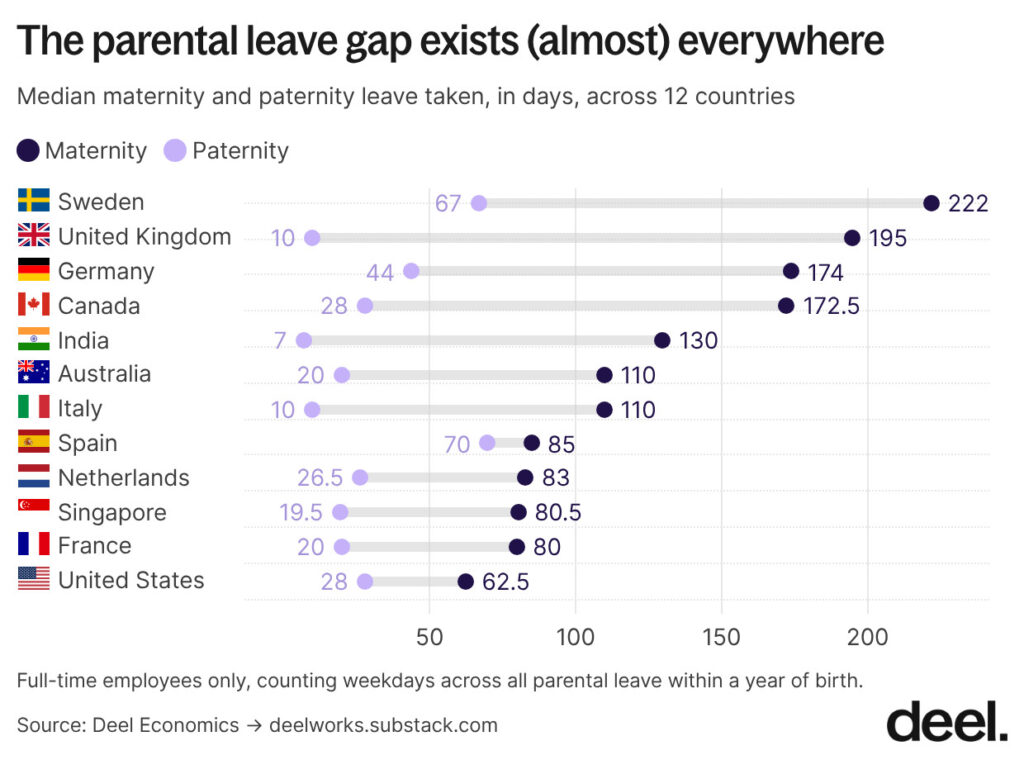
The gap between mothers and fathers is remarkably stubborn. We ran regressions on leave length across our 12 major countries, trying to find which factors were most strongly associated with leave. Occupation, age, seniority, pay, even entitlement: controlling for all of these did not change the result that fathers took less leave than mothers.
Pooling together all 12 major countries, fathers took 16.4 fewer weeks off than mothers after controlling for other factors. In the UK, this gap was 13.2 weeks; in the US, it was just under 4.
But the data also suggests a way to narrow the disparity.
Shared leave creates the widest gap
Several of the countries with the shortest paternity leave, including the UK, Australia and Singapore, give parents a shared pool to split between them. Sweden and Germany do too, but they also reserve a substantial portion for fathers that’s lost if it isn’t used. Where that reservation is small, mothers end up taking almost all of the shared leave.
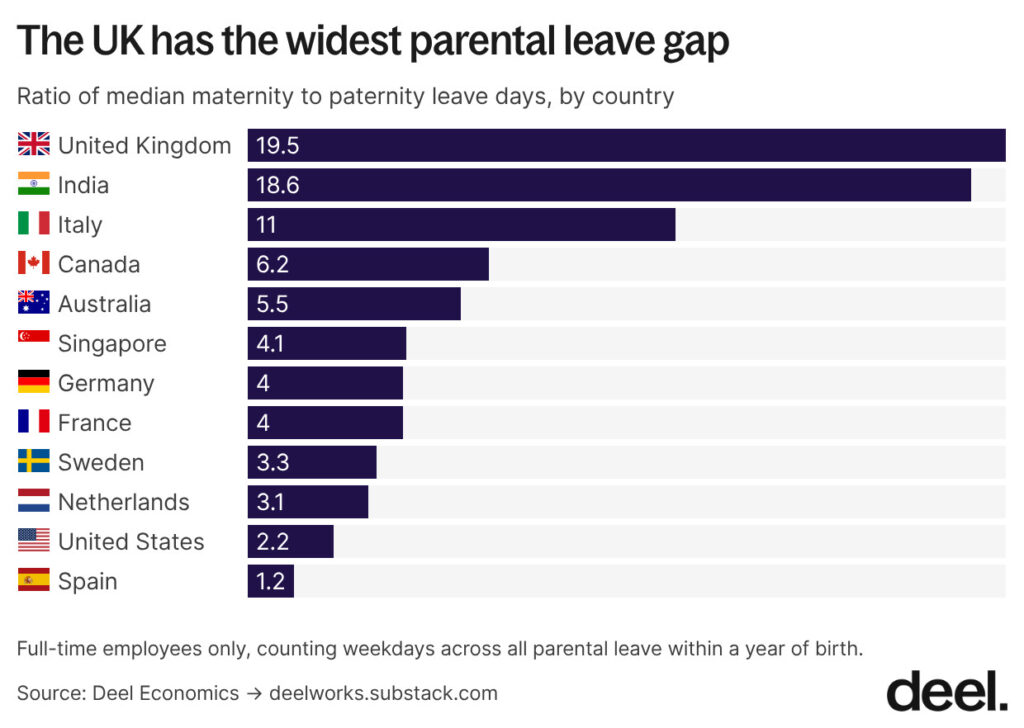
The UK is the clearest example. On paper its system looks generous: up to a year of maternity leave, two weeks for fathers, and the option for mothers to hand up to 50 weeks of their leave over to their partner through Shared Parental Leave. Yet it produces the widest maternity-to-paternity gap of any major country in our data.
Individual, non-transferable leave creates the narrowest
Spain sits on the other end of the spectrum, with identical, fully paid, and non-transferable leave for each parent. Spanish fathers take a median of 70 weekdays against 85 for mothers, the narrowest gap of any country we looked at. Our data is broadly similar to Spain’s own findings – the government recently reported that leave in early 2026 lasted an average (mean) of 114.8 calendar days (82 weekdays) for women and 110.8 calendar days (79 weekdays) for men. Our data includes earlier years in which leave was likely to be slightly less equitable.
The floor is the ceiling in paternity leave
Paternity leave closely tracks a country’s legal minimum. French fathers take a median of 20 weekdays, which equates to the 28 calendar days they were entitled to before July 2026. British fathers take 10 days, their two weeks of statutory paternity leave; anything beyond that reduces what a mother can take through Shared Parental Leave. Italian fathers take their 10 compulsory working days, and Singaporean fathers take the 20 days they’ve been entitled to since April 2025.
Swedish dads take a median of only 67 days, short of the 90 days that are reserved for each parent, but remember: this is only the leave they take within a year of birth. But Swedish leave doesn’t have to be used in that first year, and when we look at all the paternity leave Swedish fathers take, the median rises to 90 weekdays. They’re more likely than fathers anywhere else to take leave well after the birth.
The disparity isn’t just a feature of the medians. The chart below shows the full distribution of leave in four countries: the US, the UK, France and Sweden.
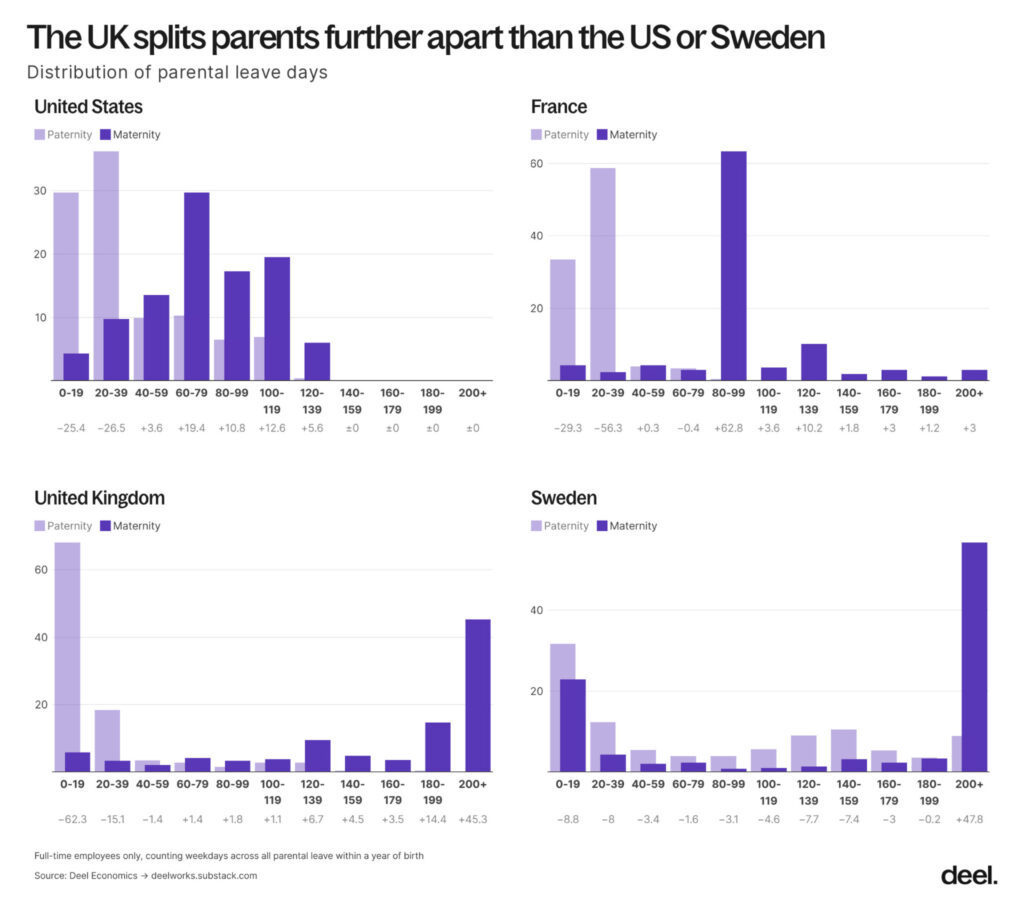
It underlines how much statutory leave serves as both a ceiling and a floor: French mothers peak at 80 days or 16 weeks – exactly the minimum number that the government required companies to offer new mothers (barring other extenuating circumstances) prior to recent reforms.
It also shows just how unequal leave is in the UK. British fathers cluster at 10 to 20 days, while mothers sit at the opposite end of the chart, with very little in between. American and Swedish parents are spread far more evenly.
American (professional) fathers take more leave than British ones
In fact, British paternity leave is so limited that American fathers, who have no federal right to paid leave at all, take significantly more of it. Among the white-collar professional fathers in our data, Americans take a median of 5.6 weeks, more than fathers in France, Italy, or the UK, all of which guarantee paid paternity leave by law.
In the UK, it seems like the legal minimum has become the norm. Whereas in the US, where the twelve weeks guaranteed for fathers by the Family and Medical Leave Act range from unpaid to Oregon’s weekly $1,700 maximum, and mothers take far less leave, white-collar fathers have filled in some of the gap.
Who is taking parental leave, and how?
Policy matters, but so does employer context. Where you work and what your employer lets you do with your leave shapes both how much time you take and how you take it.
Company size is the strongest predictor of leave length
The same regressions that show the gender gap surviving every control also show that company size is the strongest predictor of how long parents take off. We ran them across all 12 countries, and separately for the US and the UK, and the result repeated in each version. Holding other factors constant, new mothers take 79 fewer weekdays at mid-market firms and 84 fewer at SMBs than they do working for large employers.
We saw a similar pattern in both the US and the UK.
An important note: this pattern isn’t the result of large companies granting more time off (although they do that) – it showed up even after controlling for time off.
Why might this be? Part of the answer could be that larger companies offer more generous pay replacement over a longer stretch of leave, as with enhanced parental leave schemes in the UK. But the same gap appears in the US, where pay replacement varies less over the course of leave. That suggests something about larger employers makes longer leave easier to take, perhaps because they have more slack to absorb an absence: other people can cover the work while a new parent is away.
Entitlement matters, but only where it varies
Across all countries, the amount of leave parents were entitled to had no measurable effect on total time off. That’s likely because most of the variation in entitlement is between countries, and it gets absorbed once we controlled for country. As we saw above, statutory entitlements are often both the floor and the ceiling.
Within countries, though, entitlement can vary hugely by employer, particularly in the US with its patchwork of laws, and there the effect shows up clearly. Within the UK, an extra 10 days of entitlement resulted in an extra 3.7 days of time off. The US had a very similar result.
Counting parental leave alone understates time off – especially for mothers
Parental leave isn’t the only kind of time off new parents use. We looked at how often a birth episode overlapped with other paid leave, like vacation or sick leave. Whether a parent can use this type of leave is an employer’s choice.
Globally, 44% of parents took some other kind of paid leave around their parental leave. Mothers did this far more than fathers: 49.7% against 40.3%, a gap that holds everywhere we looked (p < 0.001).
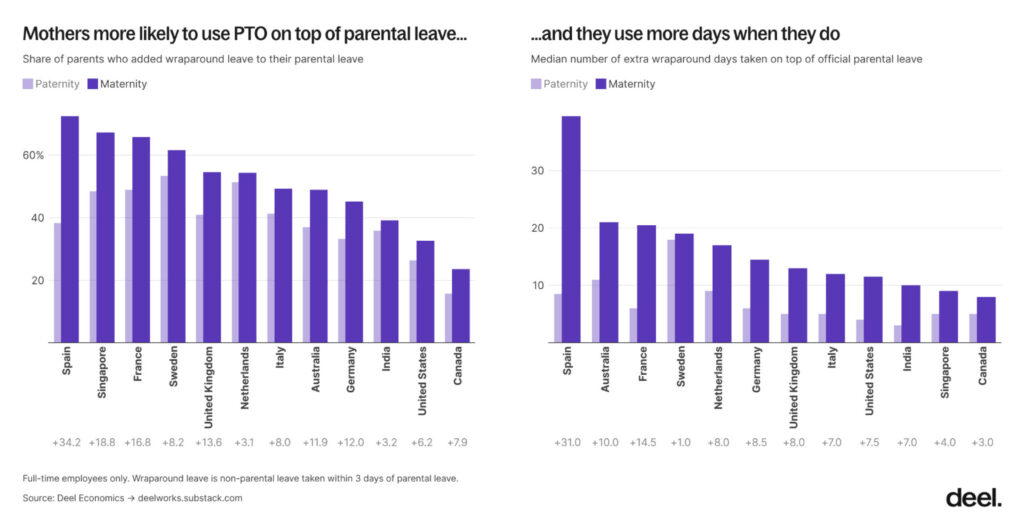
The disparity between fathers and mothers exists in every single country that we looked at, and is much larger when it comes to the number of median parental days off.
Remember Spain, home of the smallest parental leave gap? It shows the biggest disparity in the use of vacation or sick leave as extra parental leave. It seems like mothers there are still taking more time off than fathers, even though government policy is amongst the most egalitarian in the world. Looking at parental leave alone would understate this difference – which is why data points like these are so important even in countries where the government knows how much leave its citizens are taking.
This divide doesn’t seem to be driven by low leave entitlement – the US has the least generous leave policies, yet the gap is much smaller than many European countries.
So what explains it? We ran two regressions across our twelve countries: one for whether a parent took any vacation around their leave, and one for how many days they added if they did. Both control for parental leave entitlement, vacation entitlement, whether the leave was maternity or paternity, and the country itself.
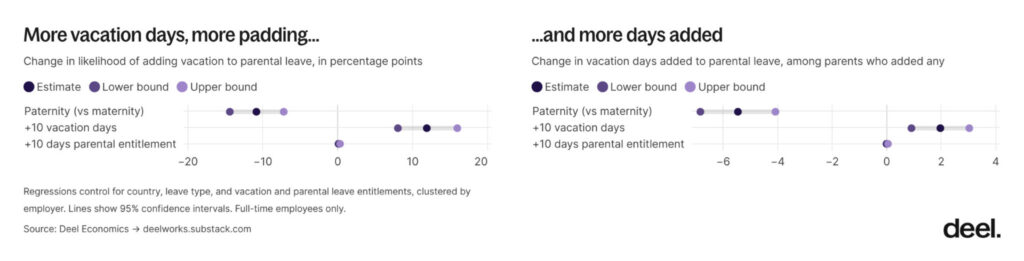
Two findings stood out to me: firstly, stock of vacation days matters much more than leave entitlement. Every 10 extra vacation days makes a parent around 12 percentage points more likely to pad their leave, and adds about two days when they do. This is likely part of why the US divide is so low here: American workers simply have fewer vacation days to draw on in the first place.
Secondly, the gap between mothers and fathers doesn’t go away – even after holding location and both vacation and parental leave entitlement constant, fathers are about 11 points less likely to pad their parental leave with vacation days, and add roughly five fewer days when they do. However, because they take so much less parental leave to begin with, a much larger percentage of their total leave is wraparound rather than parental.
Fragmented leave more common amongst new fathers
New parents have two choices about how to take their leave: in fragmented blocks or all at once. Each presents pros and cons: fragmentation may mean less disruption, but over a longer period of time, and may not always be feasible for both parents.
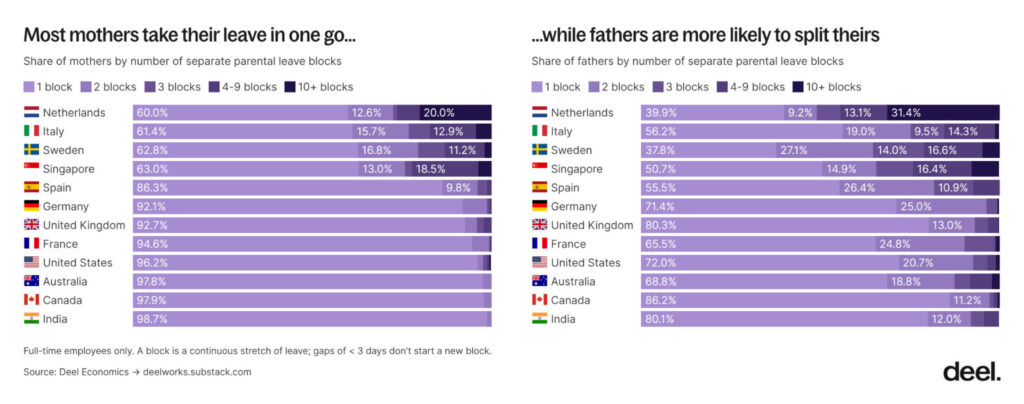
The OECD reported in a 2025 policy brief that half of fathers in Luxembourg fraction their leave, against roughly 30% of mothers. We find the same pattern in the twelve major countries that we look at: the percentage of fathers who take a single block of leave for a given birth episode is significantly lower (p < 0.001) than the percentage of new mothers who do so.
The size of the gap depends on policy choices, but also likely on employer choices. In Canada, Australia and India, over 95% of mothers and 68% to 86% of fathers take a single block, so the difference is modest. In Sweden and the Netherlands it’s enormous.
Only 60% of Dutch mothers and 40% of Dutch fathers take theirs in one stretch; Swedish fathers are lower still, at 38%. Both countries let parents draw down their leave in small pieces for years after the birth. The Netherlands has the most extreme tail of any country we looked at: 31% of Dutch fathers took theirs in ten or more separate blocks.
Fragmentation isn’t only a Nordic and Dutch story, though. Even in Spain and Italy, where leave is far more consolidated, fathers still split theirs more than mothers do. Even as the size of the gap changes, the direction does not.
The cost of parental leave
New mothers are far more likely to leave their job
A common concern that arises in discussion on parental leave is attrition, particularly as it relates to new mothers returning to work. Our data suggests that mothers are significantly more likely to leave their jobs in most countries.
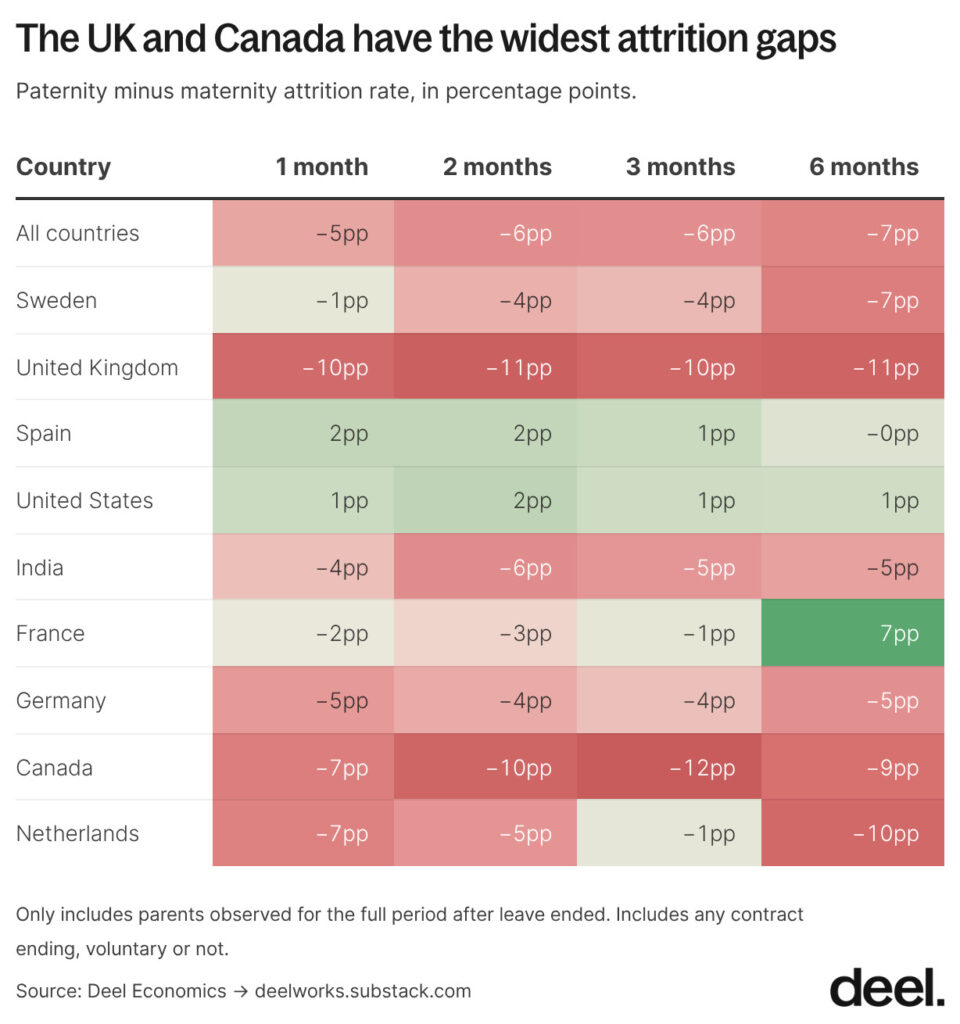
Across all 12 countries combined, 30% of mothers had left their job within six months of leave ending, against 23% of fathers. In the UK the gap between mothers and fathers ranges between 10-11 percentage points; in Canada, it reaches 12.
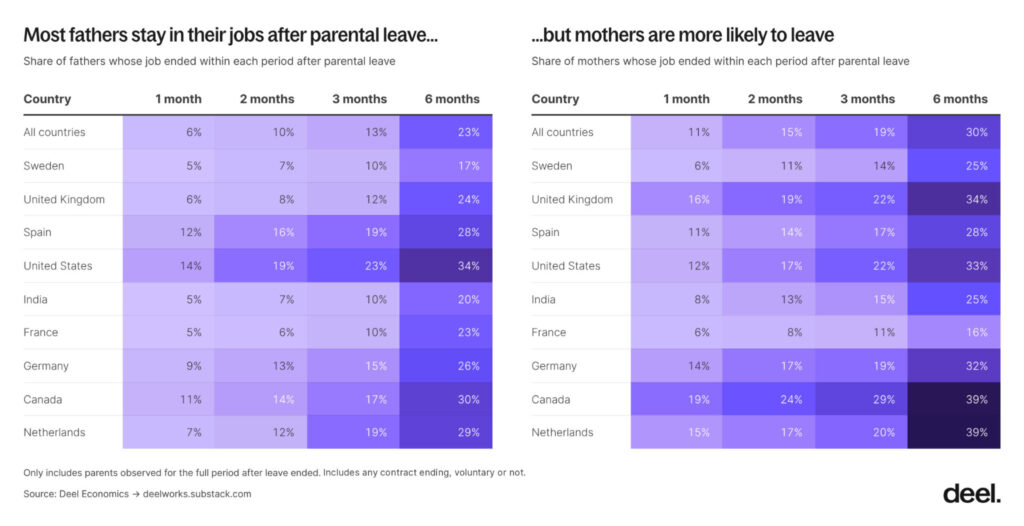
But three countries break the pattern. In the US and Spain, fathers leave at slightly higher rates than mothers throughout. And in France, the gap is marginal and changes depending on the month looked at. Interestingly, all three rely on individual leave entitlements rather than shared parental leave, the same design that likely gives Spain the narrowest leave gap in our data.
Mothers regularly receive lower pay replacement during their time off
Common in the discussion around parental leave is how much leave parents are entitled to take. Less common is the equally important concern of how much parents are getting paid during that time. Many countries with seemingly generous maternity entitlements on the surface pay little to parents during their time off.
The UK, Australia, and Canada are all examples: British mothers only receive £195 a week after their first six weeks off; Australian mothers receive minimum wage, and Canadians get 55% of their earnings (up to $729 CAD a week). Others, like Italy, have shorter leave entitlements but a much higher rate of pay replacement.
As a payroll company, we can measure how much parents are receiving in pay during their parental leave. The chart below shows average pay replacement rates for new mothers and fathers in countries where parents receive their pay through their employer payroll, rather than directly from the state.
One note: in US states with paid family leave (PFL), some portion is paid by the state directly – a comparison of the two groups shows a similar gap between maternity and paternity pay, with slightly higher replacement rates in maternity pay in non-PFL states (88% in months 1-2 and 89% in months 3-4) and very little difference in paternity pay.
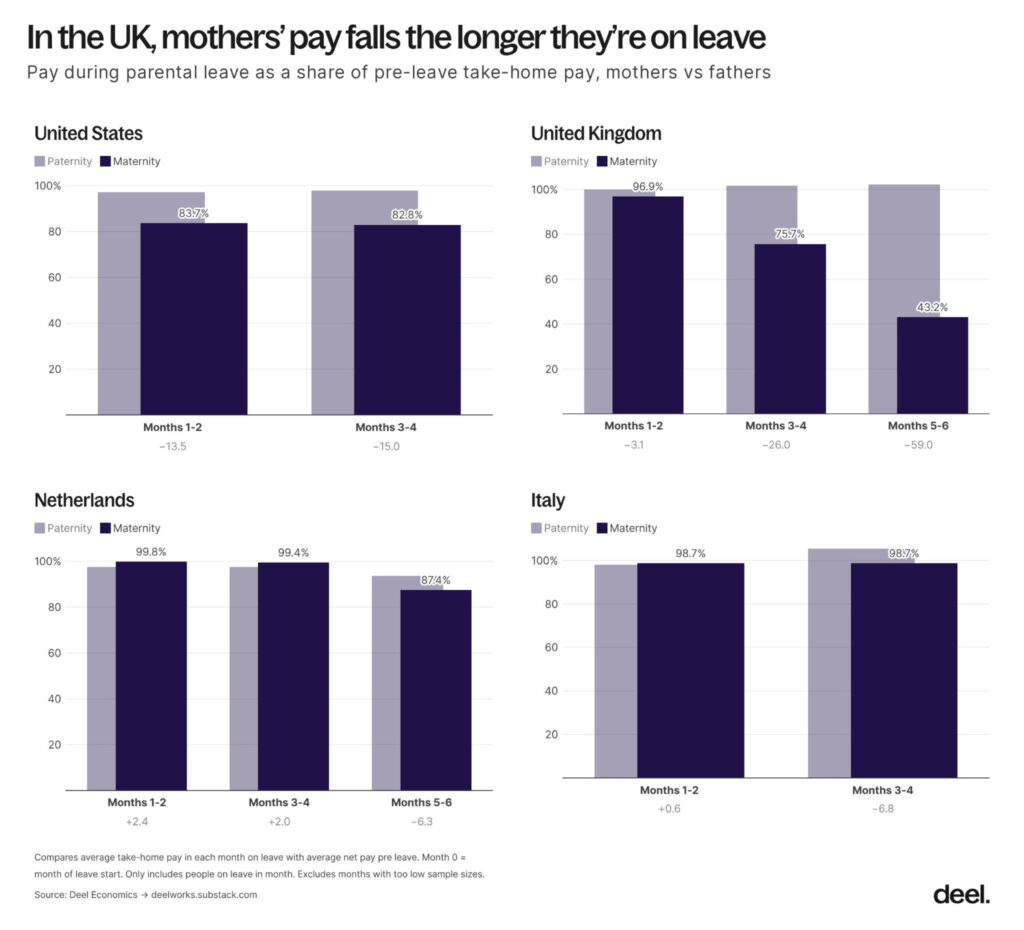
Women accept pay drops during their parental leave, whereas men who take long parental leave are paid in full. This is likely the result of a selection effect, where the only men who stay on parental leave that long are those being paid near full pay, which suggests that pay replacement is a much stronger motivation for new fathers than new mothers.
The UK is very much the outlier here. Mothers still on leave after four months see their pay drop below half, while their counterparts in the US, the Netherlands and Italy stay near full pay throughout. This is likely related to the structure of each country’s parental leave policy: the UK relies on long but partially compensated parental leave, US employees mostly rely on employer top-ups, and government policy in Italy and the Netherlands requires shorter but more well-compensated leave.
Over and over again, our data demonstrates that equity between mothers and fathers is still a long way away. But the countries that come closest show that policy can narrow the gap when it’s designed to.
Methodology
Data. The full dataset covers 7,285 parents across 97 countries between 2021 and 2026: 4,116 on paternity leave, 3,076 on maternity leave, and 93 whose leave type we cannot identify. This piece focuses on twelve countries with enough volume for reliable results — Sweden, the UK, the US, Germany, France, India, Spain, Canada, the Netherlands, Italy, Singapore and Australia — which together account for just under 5,000 of those parents. In this sample, 56.7% of episodes are paternity, 41.5% maternity and 1.8% unknown; unknowns are excluded from any comparison between mothers and fathers.
We use anonymised time-off, payroll and HR records for employees on Deel (independent contractors are excluded) who took parental leave in this window. Organisations that don’t permit their data to be used for research are excluded, as is Deel’s own workforce, and we do not include caregiving leave, such as Sweden’s vård av barn.
Note: “X parents” (e.g. “Swedish mothers”, “British fathers”) refers to parents living in that country, rather than parents of that nationality.
Birth episodes: Parental leave often isn’t taken all at once. More than half of the Swedish and Dutch parents in our sample took theirs in two or more separate blocks, which means that counting each absence on its own would make them look like they’d taken much less time off than they really had.
To get around this, we grouped leave into “birth episodes”. Each person’s longest stretch of parental leave is designated as their ‘anchor’; any leave they took within a year on either side of the anchor is summed up. This means someone who took 2 weeks parental leave, then returned to work for a month, then took another two weeks, will show up as having taken four total weeks leave.
This isn’t perfect. Someone with two children in the dataset will only be counted for one of them. In practice this isn’t much of an issue, since only 10% of parents have any leave outside their 24-month episode.
Maternity or paternity leave: Most parental leave policies are labelled as either maternity or paternity leave. For those that are not, we use an employee’s self-reported gender to determine which type of leave they used. A small share of employees had not reported gender and had taken parental leave; we inferred their gender from first name only and country of citizenship using a Claude Sonnet model. The model was tested against 103 employees with hand-labelled gender, resulting in 97% accuracy (similar across men and women).
Leave length. All figures are on weekdays, Monday to Friday. Requests within three days of each other are merged into a single absence, and absences within a year either side of a person’s longest parental leave are combined into one birth episode. Keeping-in-touch days and employer top-up policies are not counted as separate leave.
Wraparound leave. Non-parental paid leave, such as vacation or sickness, that falls inside a birth episode and falls within 3 days of the start or end of a single parental leave request (e.g., if maternity leave ended on a Friday and the employee started vacation Monday, the vacation would count as wraparound leave). The regressions in that section use vacation days only to ensure a like-for-like comparison.
Pay replacement. Monthly net pay in each month a parent was on leave, divided by their average monthly net pay in the three months before leave began, excluding any earlier leave months. Only regular payroll runs are used. In US states with paid family leave, part of the benefit can be paid outside payroll; figures for non-PFL states were tested separately and had very similar results.
Attrition. A contract ending within one, two, three or six months of leave ending. At each horizon we only count parents who have been observed for that long since their leave ended. Contract end includes resignation, dismissal and fixed-term expiry.
Regressions. OLS with leave length in weekdays as the outcome, run separately three times: for mothers, fathers and both together, across all twelve countries and separately for the UK and US (resulting in nine regressions). Controls are age at leave, log annual pay, seniority, number of days of parental leave entitlement, occupation department (R&D, G&A, S&M, or COGS), company segment (mid-market, SMB, and enterprise) and country fixed effects. We use employer-clustered standard errors. All results reported are significant at p < 0.01.
Statistical tests. Any distribution comparisons (e.g. UK-US paternity leave) use a Mann-Whitney U test (p < 0.001). Fragmentation differences between mothers and fathers are calculated using a two-sample test of proportions and are significant at p < 0.001 in every country except the Netherlands (p = 0.002), Italy and Singapore (not significant).
Data protection & AI compliance. Where AI was used in this analysis, specifically for gender inference on a small subset of records, this was conducted only with AI providers operating under zero data retention agreements and appropriate data processing agreements compliant with GDPR and relevant privacy frameworks. All AI-assisted classification was tested against a baseline sample for accuracy before application. The dataset does not include health data or any data relating to minors.
All other data was anonymised and aggregated before the analysis described above.