For many salons, the cost of delivering a service is still calculated in minutes, product use and stylist skill. Energy, by comparison, is often treated as a fixed overhead; something that appears on the bill at the end of the month rather than a variable cost that changes from one appointment to the next.
But as one in five hair and beauty businesses operate at a loss, according to the NHBF, and almost three quarters of salon owners expect operating costs to rise further, understanding where energy demand actually sits within the working day is becoming a more practical business question.
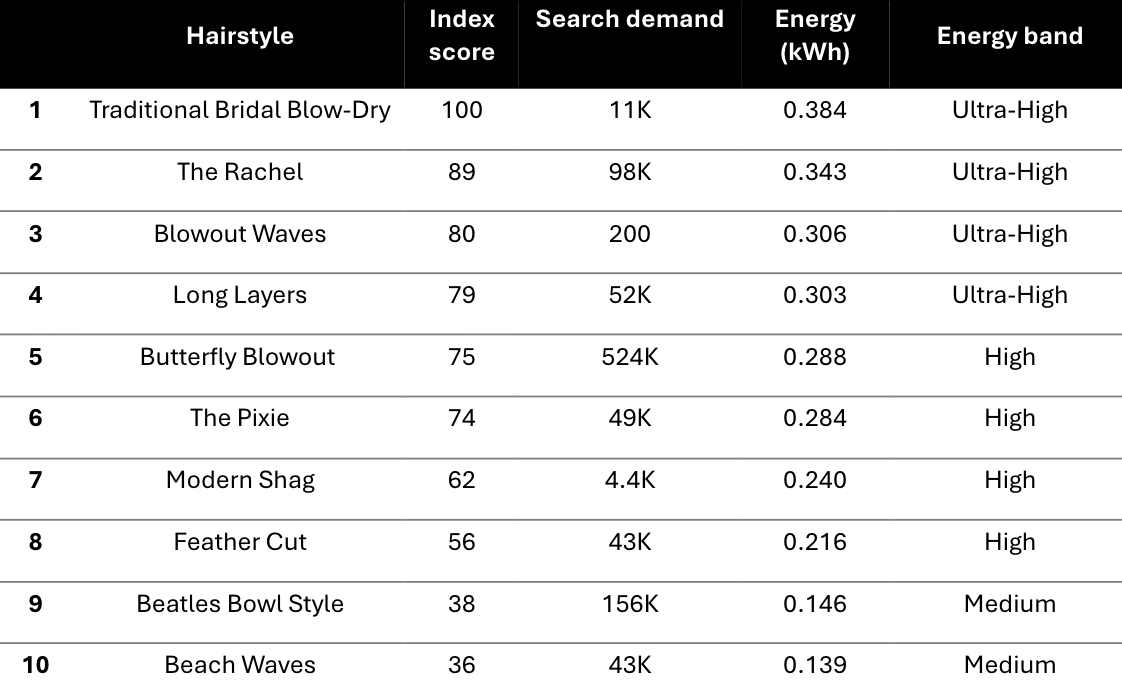
New analysis from Valda’s Energy Cut Index offers a useful lens for salon owners because it does not simply list trending styles; it estimates the heat-styling demand behind them. By analysing 20 popular looks according to active heated-tool use, the index highlights how dramatically energy consumption can differ between services that may sit close together on a salon menu.
The headline finding is that a Traditional Bridal Blow-Dry is the most energy-intensive style in the study, using approximately 0.384 kWh per session and sitting in the ultra-high energy band. The Rachel follows closely at 0.343 kWh, with Blowout Waves and Long Layers also among the highest-ranked looks.
For salon teams, the value of the data lies less in naming a single ‘expensive’ style and more in identifying a pattern. Volume finishes – particularly those requiring prolonged blow-drying, section-by-section shaping, curling or smoothing – place the greatest demand on heated tools. That matters when the same type of finish is repeated across a busy column, bridal party or peak Saturday.
By contrast, lower-energy looks such as Pin Curls, Textured Low Buns and Boho Braided Up-dos rely more heavily on setting, texture, hand-finishing and dressing-out skills than on sustained heat. That does not make them lower value services, but it does show why energy should be considered alongside time, skill level and product when assessing profitability.
For independent stylist Milli Brown, the findings reflect a gap in how many businesses currently think about day-to-day energy use:
“Hair and beauty businesses operate in an environment where heated tools are essential and often in near-constant use. But this is rarely something that gets actively measured. What the Energy Cut Index makes clear is how much variation there can be between different styles-even ones that might look quite similar from a client perspective.
“From a business point of view, having that visibility is useful. It helps you think more clearly about how you’re managing time, equipment and costs across the working day.”
For owners, that visibility can support more informed decisions across several parts of the business: how long certain services are booked out for, whether high-heat work is clustered or spread through the day, when equipment is switched on, and whether certain finishes should be costed differently from lower-energy alternatives.
This is particularly relevant for salons balancing client demand for polished, social-first finishes with rising fixed costs. Styles such as The Rachel and the Butterfly Blowout continue to resonate because they deliver movement, volume and recognisable shape, but they also tend to require careful sectioning, controlled airflow and repeated heat application to achieve a professional finish.
What salon owners can take from the data
The index should not be read as a reason to discourage high-demand, high-impact services. Instead, it gives salons another layer of information when reviewing menus and margins. A high-energy blow-dry may still be highly profitable if it is correctly priced, efficiently booked and delivered with the right tools. The risk comes when these services are treated as standard finishes while absorbing more time, heat and operational cost than the price reflects.
A useful starting point is to review the services that repeatedly require multiple heated tools or extended finishing time. Salons may want to look at whether these appointments are clearly described on the menu, whether junior and senior stylists are using consistent techniques, and whether longer heat-based finishes are being absorbed into broad service categories rather than charged as specialist work.
There is also a training opportunity. Faster sectioning, better nozzle control, appropriate heat settings and choosing the right tool for the finish can reduce active styling time without lowering the standard of the result. In a busy salon, small reductions in heat use per client can become meaningful when repeated across the week.
Valda Energy built the index by analysing professional styling footage to calculate average active heated-tool use per style. Each look was mapped to the tools required, with wattages based on professional UK brands, before energy consumption was calculated and scored out of 100.
Across the full ranking, Valda found a 384-fold difference between the most and least energy-intensive styles. Blow-dries, waves and layered, volume-led finishes consistently ranked highest, while styles built around texture, braiding and natural finish sat towards the lower end of the scale.
Daljeet Kaur, Chief Operating Officer at Valda Energy, says the aim is to make energy data easier for small business owners to apply in everyday decision-making.
“This is about giving smaller salons clearer insight into where energy demand sits within their day-to-day operations, so they can plan more effectively – whether that’s around scheduling, service delivery or overall efficiency.
“It’s about understanding your own patterns and making more informed decisions, without compromising client experience or service quality.”
For salon owners, the takeaway is not that trend-led finishes should be avoided. It is that energy belongs in the same conversation as appointment length, product usage, staffing level and service pricing. As costs continue to rise, the salons with the clearest view of what each service really takes to deliver will be best placed to protect both margins and client experience.